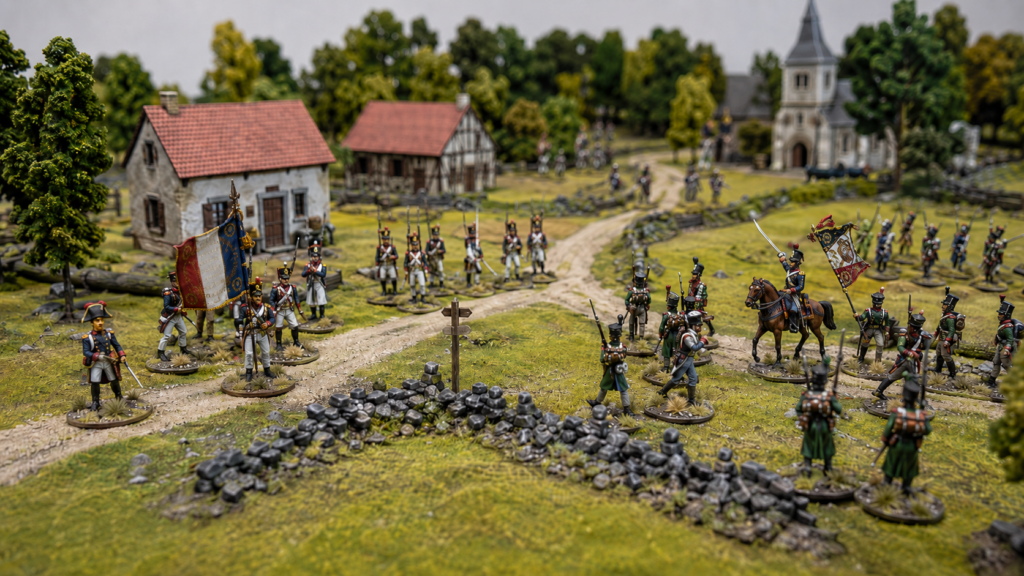
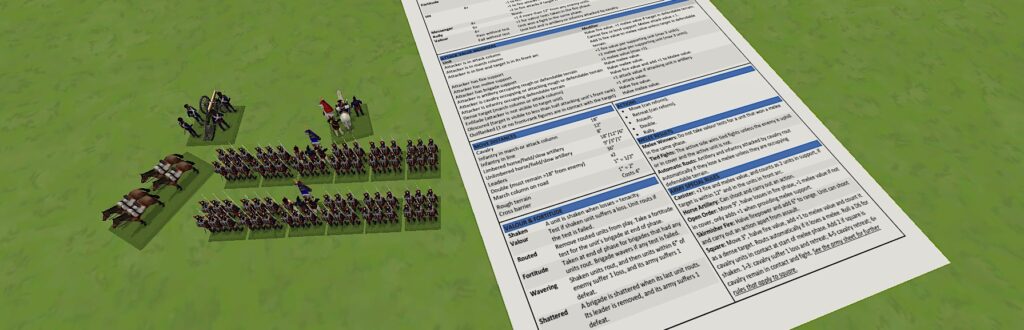
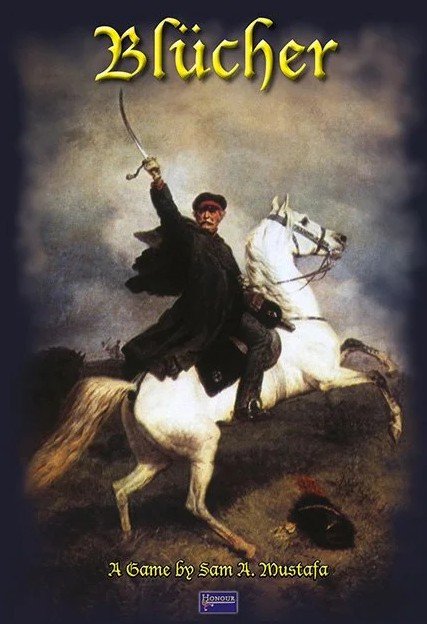
The Blücher wargame rules set, published by Sam Mustafa from his Honour Games collection, is a very popular Napoleonic wargame that provides some unique ‘grand tactical’ game mechanics. One of those unique game mechanics include command friction in the form of Momentum Orders.
In this article, we are going to take a look at what makes Blücher such a popular historical wargame, and how you can get into the game on your own – or in your club.
What Blücher wargame rules are and what you need to play
Blücher is one of the top brigade-scale Napoleonic wargames, allowing for high-level maneuver and an operational feel on the tabletop. At this scale, whole Napoleonic battles can be fought on a 4’ x 6’ tabletop. What “brigade-level” means in play is that you are commanding infantry units of 2,000-3,000 men (approximately 4-6 battalions), cavalry units of 1,000-2,000 men (approximately 6-12 squadrons), or artillery units that comprise 18-24 guns (or approximately 2-4 batteries). But, this scale can be altered to create very large battles.
The formations of the units at this scale are abstracted – units do not form line or column. But units can become ‘prepared’, as in forming square. And they can ‘garrison’ built-up areas. Otherwise, the formations of the individual battalions in the units are details better left to that unit’s ‘brigade commander’
Scale: time, distance, and what units represent
A unit on the tabletop can represent a brigade in some armies, or divisions in other armies. This is generally determined in the scenario and the Table of Organization of the army, based on the period of the Napoleonic Wars. Within each unit, there can be a mix of unit types, providing different unit traits. Some units may be all cavalry or all infantry. Artillery batteries can be distributed amongst the units, giving those units extra ranged fire attack. If cavalry is attached to an infantry unit, it provides extra defensive value.
The Blücher wargame rules can be scale agnostic. A game can be played using 6mm figures or 28mm figures. The scale is determined by the Base Width (BW) of the units. In the basic rules, 1BW is 3” or 75mm. All movement and firing distances are based on a number of BWs. This makes it one of the more flexible Napoleonic games for beginners.
What you need to play Blücher wargame rules
- The Rulebook + dice + measuring method / basing conventions
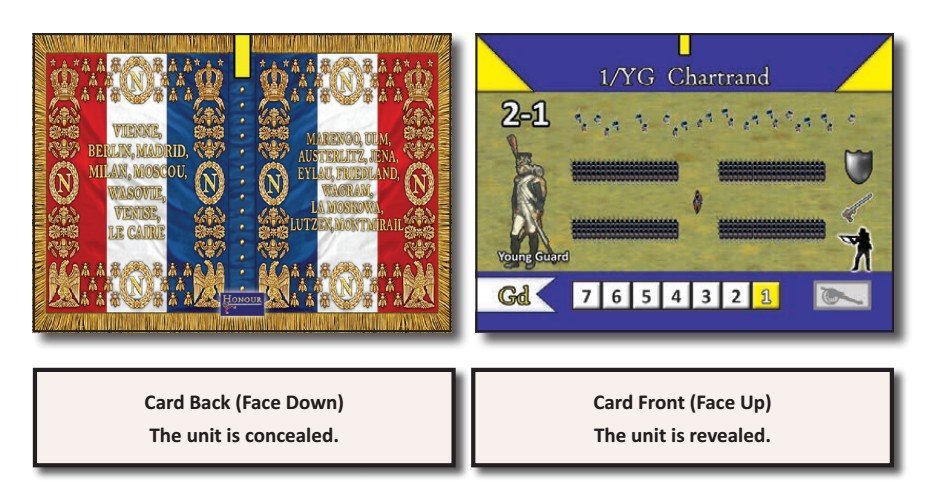
- Units (either miniature figures or unit cards), terrain, markers (fatigue/morale/command markers as needed)
- A short “minimum viable setup” for a first game
Core turn structure + command/momentum
Blücher wargame rules are an alternating IGO/UGO turn based wargame. The number of game turns can vary based on the scenario, but is usually based on a full day’s activity of 30 turns – fifteen turns for each player.
In each side’s turn in Blücher involves five steps – 1. the information phase, 2. the movement phase, 3. the fire phase, 4. the combat phase, and 5. the status phase. At the end of these steps, the turn ends. The next turn begins with the opposing player repeating these five steps.
The Movement Phase and Momentum Orders
At the beginning of each player’s turn, the opposing player secretly rolls a set of D6 dice (2-3, depending upon the scenario). The result of that die roll determines how many Momentum Orders (MO) the active player has to utilize that turn. The unknown number causes the real ‘command friction’ for the player, as they have to prioritize their orders. They may only have a few Momentum Orders, which means only one or more units may be able to be activated and moved. After each activation, the active player will ask their opposing player to compare the die roll with the number of MOs used to determine if the player may continue to activate units. Once the active player reaches the die roll total, their movement phase ends. This one game mechanic helps to create the feel of Napoleonic command.
Moving your units using MO
Momentum Orders can be expended in several ways and in this order:
- Momentum Orders can be used to activate 2 or more units within one corps, which would expend 1 MO per activated unit. All Corps level orders must be made before any other type of order can be issued.
- Next, Momentum Orders can be used to activate a single unit. Activating single units expend 2 MO per activated unit. This is useful if a unit has become separated from its corps or if the player wants to rally of some lost elan on that unit.
- Finally, a Commander in Chief (CiC) can be placed anywhere on the table to activate any or all units within a certain radius of the CiC. This activation is the last step in the movement phase.
There are additional movement rules that can allow a corps (or units of a corps) who have not become ‘visible’ to the opposing player to make longer and more fluid moves. These units start in a concealed fashion, but must end their turn revealed.
Voluntary Movement – Simple Moves, Difficult Moves, and Charges
Movement is abstracted to allow for the movement and re-orientation of units of brigade or larger size. All units have a movement range for a Simple move and a Difficult move. A simple move allows a unit to pivot freely at the start of its move and then move a distance in a straight line. If a unit is wanting to reposition in a unique way or move through rough terrain, they will make a Difficult move, which is half the movement distance of the Simple move. This allows a unit to pivot at the beginning and the end of its movement. Or, in the case of rough terrain, it slows the unit’s movement distance.
A Charge is the only type of movement in which a unit can move into contact with the enemy and it may use its full movement allowance, no matter what the terrain is.
The Fire combat
The fire combat phase allows units that have not activated and moved during the previous phase to perform fire combat. This could include infantry volley fire, infantry skirmish fire (for those units that have that trait), artillery canister or long range fire. The firing range distances of each weapon type is determined by xBW. For instance, infantry volley fire can be performed within 1BW of the front face of the firing unit. Artillery batteries have a range of 8BW.
A unit fires using a D6 for each of its current ‘elan’, or in the case of artillery, it’s current ‘ammo’. Each roll of ‘six’ scores one hit on the target unit. In some cases, a bonus would allow one ‘five’ to score a hit. And in other cases, a unit’s penalty will cause the D6 count to be halved.
Once hits are scored on a target unit, it loses that number of ‘elan’ that is remaining, or in the case of artillery, it’s ammo.
The Combat phase
If any units of the active player mad any charges during their movement phase, then combat is resolved in this combat phase. The attacking unit has a certain number of combat dice to roll based on its elan that must be allocated to one (or more) defending units that it is in contact with. The defending (passive) unit(s) also has a number of combat dice, equal to the current elan.
The defending unit(s) roll their dice first to determine the unit’s defensive score. Then the attacking unit(s) roll their combat dice to determine the attack score.
Based on these two scores, the outcome of the combat is determined. Units from either/both sides take fatigues (lose of elan), and/or retreat. In some case, a unit might be broken or be forced to retire from combat completely.
Morale and the the battle’s breaking point
A unit’s morale is reduced by loss of elan points, which represent its strength and fatigue levels. If a unit is reduced to one elan, it’s possible actions are limited. Once the unit loses that last elan, it is destroyed and removed from play.
The morale of the army is determined at the beginning of the game by adding the number of infantry and cavalry units and dividing that total by three, rounding up any fraction. If reinforcements arrive later, those units will increase the morale of the army by a similar calculation. But, as each unit is removed from the table, one point is removed from the Army’s morale. Once an army loses all of its Morale, it is defeated.
The Scharnhorst campaign system overview
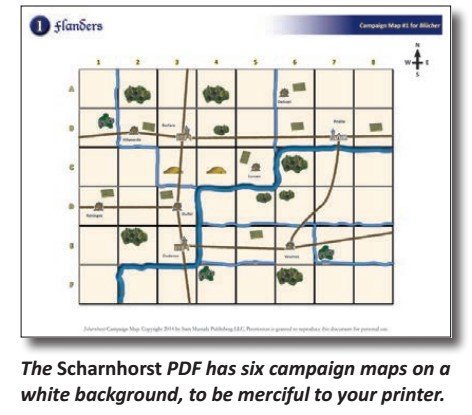
Scharnhorst is a unique campaign system that enables players to create fictional battles in an historical setting, using armies that they have created for the Blücher wargame rules.
Scharnhorst acts as a “pre-game” for the Blücher wargame rules that allows two opponents to play to determine the final configuration and army strengths on a tabletop battle. This campaign campaign should take 20-30 minutes, and will result in a unique tabletop battle with its own context, terrain, and victory conditions.
The Honour website provides FREE downloadable Scharnhorst Campaign maps for you to use. In addition, the publisher has created campaign supplements, the first being “The Hundred Days”, which is also downloadable.
An Active Gaming Community
The Blücher wargame rules have one of the most active gaming communities, driven by the proactive game developer who has worked to develop scenarios for many of the major Napoleonic battles. These well-researched and beautifully published scenario PDFs allow players to set up the tabletop and units to fight historical battles, such as The Battle of Grossbeeren.