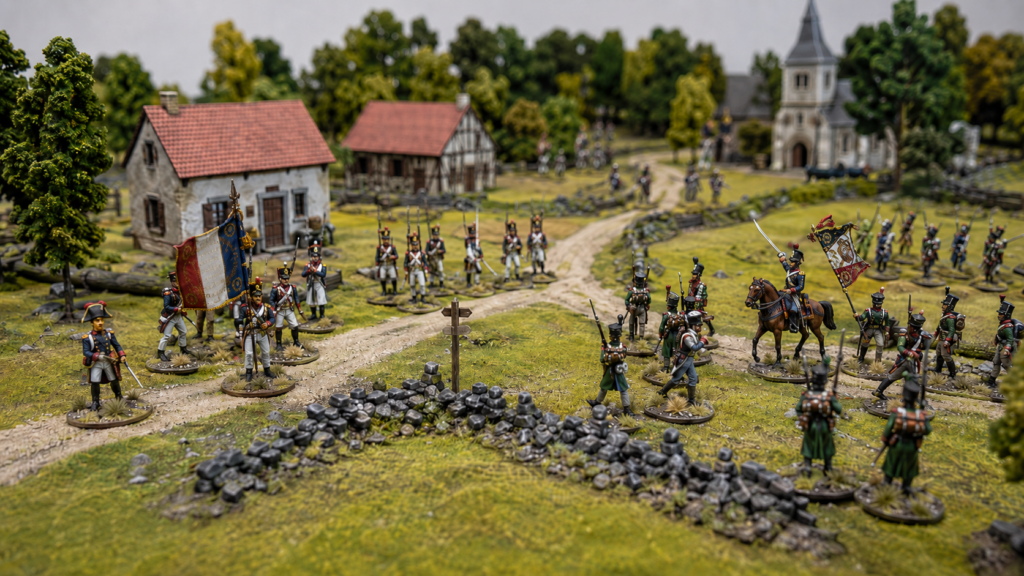
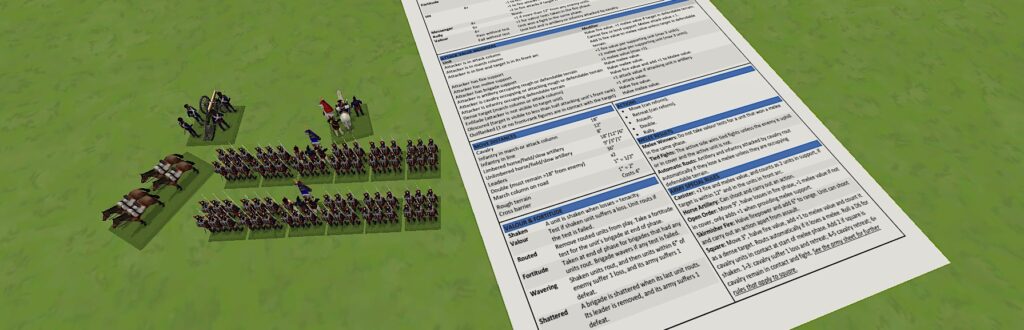
Napoleonic wargames occupy a special place in historical tabletop gaming. Few periods offer the same mix of sweeping battlefield drama, colorful armies, tactical variety, and command-level decision-making. From the disciplined volleys of British infantry to the massed columns of the French, from cavalry charges at the decisive moment to artillery batteries shaping the battlefield from a distance, the Napoleonic Wars provide everything tabletop players need for tense, visually striking, and historically rich games.
But the appeal of Napoleonic wargaming goes beyond uniforms and famous battles. This period forces players to think like commanders. Should infantry advance in column or deploy into line? When should cavalry be committed? Can artillery soften the enemy before the assault? Will a brigade obey orders, stall under pressure, or collapse when morale begins to fail? These decisions are what make Napoleonic wargames so rewarding, whether played with miniatures on a physical table, through a board game, as a solo campaign, or inside a virtual tabletop environment.
The challenge for many players is knowing where to begin. Napoleonic wargames cover a wide range of scales and styles. Some skirmishing rules for Napoleonic wargaming provide exciting narrative actions. Others recreate battalion-level tactics, grand tactical battles, or full corps and army-level engagements. A player looking for a fast club game may need a very different system than someone who wants to refight Waterloo, run a Peninsular War campaign, or play solo using Tabletop Simulator.
This guide is designed as a starting point for anyone interested in Napoleonic wargames. It explains what makes the period unique, compares the major rulesets currently in use, looks at the difference between tactical and grand tactical play, and shows how virtual tabletop tools can make the era more accessible. Whether you are new to historical miniatures or already have armies on the table, the Napoleonic period offers one of the richest and most flexible settings in all of tabletop wargaming.
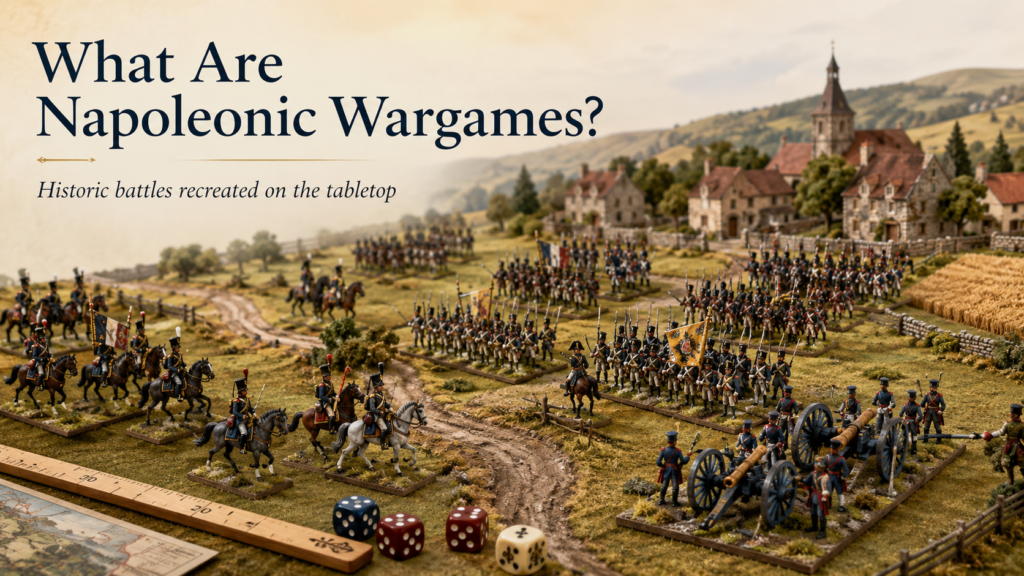
What are Napoleonic Wargames?
Napoleonic wargames recreate the battlefield problems faced by commanders during the French Revolutionary and Napoleonic Wars. It can also include the American-British engagement of the War of 1812. These games are not simply about moving painted miniatures across a table. They are about managing formations, timing attacks, coordinating cavalry and artillery, preserving morale, and making difficult command decisions under pressure.
At their best, Napoleonic wargames make players think beyond individual units. A battalion may look strong on its own, but its value depends on where it stands, what formation it uses, whether its flanks are protected, and whether nearby cavalry or artillery can support it. A well-timed infantry advance can break an enemy line. A poorly timed attack can leave troops exposed to artillery, cavalry, or counterattack.
What are Some of the Defining Features of Napoleonic Wargaming
Formations
One of the defining features of Napoleonic wargaming is the importance of formation. Infantry might advance in column, deploy into line, form square against cavalry, or send out skirmishers to disrupt the enemy. Each choice has trade-offs. A column may move quickly and attack with momentum, but it can be vulnerable to fire. A line can deliver more musketry, but it is harder to maneuver. A square can resist cavalry, but it becomes an easy target for artillery.
Cavalry
Cavalry adds another layer of tension. In many Napoleonic wargames, cavalry is not simply a fast-moving attack arm. It is a threat that shapes the entire battlefield. Infantry must respect it. Commanders must decide when to commit it. Send cavalry too early, and it may become exhausted or countered. Hold it too long, and the opportunity may disappear. This makes cavalry timing one of the most dramatic parts of the period.
Artillery
Artillery also plays a central role. Batteries can soften enemy formations, defend key ground, support assaults, or punish troops caught in the wrong formation. In tabletop terms, artillery often becomes a tool of preparation and pressure rather than instant destruction. It forces movement, shapes decisions, and can turn a fragile position into a strong one.
Command and Control
Command and control is another reason Napoleonic wargames feel different from many other tabletop periods. Players are often asked to manage brigades, divisions, corps, or entire armies rather than isolated units. Orders may be delayed. Commanders may fail to activate. A formation may stall at the wrong moment. These rules create the friction that made real Napoleonic battles so difficult to control once thousands of men, horses, and guns were in motion.
Morale
Morale is equally important. Napoleonic armies did not usually collapse because every soldier was destroyed. They broke when formations lost cohesion, officers lost control, units were flanked, or the psychological pressure of fire, casualties, cavalry, and confusion became too much. Good Napoleonic rules reflect this by making morale, fatigue, and command disruption as important as raw casualties.
National Traits
The period also rewards players who enjoy national differences. French, British, Austrian, Russian, Prussian, Spanish, Portuguese, and allied armies all bring different strengths and weaknesses to the tabletop. Some armies excel at aggressive maneuver. Others are known for discipline, staying power, artillery strength, cavalry quality, or defensive resilience. These differences give Napoleonic wargames much of their replay value.
This is why understanding the rules matters. A player who knows only how to move and roll dice may miss the real decision-making underneath the game. A player who understands formations, turn sequence, morale checks, command limits, and combat resolution will get much more from the period.
For a broader introduction to how tabletop rules structure historical games, see this site’s guide to how tabletop wargame rules work. This article is a useful starting point before choosing a specific Napoleonic ruleset, because every rule system handles movement, combat, morale, and command friction differently.
Why the Napoleonic Wars Are So Popular for Historical Tabletop Wargaming
The Napoleonic Wars remain one of the most popular periods for historical tabletop wargaming because they combine spectacle, tactical variety, historical drama, and meaningful command decisions. The period offers more than rows of troops and colorful uniforms. It gives players a battlefield where formations matter, timing matters, morale matters, and every army has a distinct personality.
For many players, Napoleonic wargaming sits in a sweet spot between visual appeal and strategic depth. The battles are large enough to feel sweeping and dramatic, but still structured enough that individual decisions on the tabletop can change the outcome. A single brigade attack, a cavalry charge held in reserve, or an artillery battery positioned on the right hill can create the kind of turning point that makes a game memorable.
Colorful Armies and National Character
One of the first things that draws players to Napoleonic wargames is the visual character of the armies. The period is filled with striking uniforms, national flags, distinctive cavalry types, colorful artillery trains, and recognizable commanders. A Napoleonic tabletop can look spectacular, whether it is played with 6mm armies on a grand tactical map or 28mm miniatures in a smaller battlefield scenario.
But the appeal is not only visual. Each major army brings a different battlefield identity.
The French army is often associated with aggressive maneuver, flexible corps organization, strong artillery support, and the ability to concentrate force at the decisive point. French infantry columns, skirmish screens, and bold attacks give many games their offensive energy.
The British army brings a different character. British infantry is often represented with strong fire discipline, defensive steadiness, and the ability to hold ground under pressure. In Peninsular War scenarios especially, the classic image of British lines meeting French columns remains one of the defining tabletop matchups of the period.
The Austrians offer mass, resilience, and organizational challenges. Their armies often reward players who can manage large formations, coordinate attacks carefully, and absorb pressure while trying to bring numbers to bear.
The Russians are frequently modeled as tough, stubborn, and difficult to break. They may not always move with the speed or flexibility of the French, but their staying power makes them formidable in long, grinding battles.
The Prussians provide one of the most interesting army arcs of the period. Early-war Prussian forces can feel rigid and brittle, while later-war Prussian armies reflect reform, renewed energy, and coalition warfare.
Spanish and Portuguese forces add even more variety. Spanish armies can create unusual battlefield problems, especially when combined with guerrilla warfare, uneven troop quality, and difficult terrain. Portuguese troops, especially under British influence in the Peninsular War, offer a compelling example of an army transformed through training, command reform, and battlefield experience.
This variety gives Napoleonic wargames enormous replay value. Players are not simply choosing different colors of the same army. They are choosing different battlefield problems.
More about Formations
As we stated earlier, Napoleonic wargaming is popular because formations are central to the action. In many periods, a unit’s position matters more than its exact formation. In Napoleonic games, formation often determines what a unit can do, how vulnerable it is, and what risks it faces.
Infantry in line can deliver stronger musket fire, but it may be harder to maneuver. Infantry in column can move more quickly and attack with momentum, but it may suffer against disciplined volleys or artillery. A square can protect infantry from cavalry, but it limits movement and makes the unit vulnerable to artillery fire. Skirmishers can screen an advance, harass enemy formations, and disrupt command plans, but they usually cannot hold ground against formed troops.
Cavalry creates another layer of decision-making. Light cavalry can scout, screen, pursue, and exploit openings. Heavy cavalry can deliver devastating shock at the right moment. But cavalry is rarely useful if thrown forward without preparation. A dramatic charge may win a flank or shatter a weakened enemy, but a mistimed charge can leave expensive troops blown, disordered, or counterattacked.
Artillery adds pressure and shape to the battlefield. Guns can anchor a defensive position, soften an enemy before an assault, break up dense formations, or punish troops caught in square. In many Napoleonic wargames, artillery is not just a casualty-producing weapon. It is a tool for forcing the opponent to move, deploy, or respond.
Prepared positions, villages, ridgelines, bridges, river crossings, and road networks also matter. Terrain is not simply decoration. It shapes formation choices, line of sight, artillery placement, cavalry threats, and the timing of reserves. This is one reason Napoleonic battles work so well on the tabletop: the rules naturally connect the look of the battlefield to the decisions being made.
Command Friction Is Central
Napoleonic games are at their best when they do not allow every unit to behave perfectly. The period was defined by large armies, imperfect communication, delayed orders, uncertain intelligence, tired troops, and commanders trying to control events across smoke-filled battlefields. Good Napoleonic rules reflect that friction.
Unlike some modern games where units can act freely as long as the player wants them to, many Napoleonic wargames force players to work through command structures. A player may need to manage brigades, divisions, corps, or entire armies. Orders may be issued through commanders. Units may need to remain within command range. A brigade may hesitate. A division may fail to activate at the right moment. A commander may not be where he is needed when the battle shifts.
This is not a flaw in Napoleonic wargaming. It is one of the period’s great strengths.
Command friction forces players to make realistic choices. Do you keep your brigades close together for control, or spread them out to cover more ground? Do you commit the reserve now, or wait for a clearer opportunity? Do you use a commander to rally battered troops, support an attack, or push forward a delayed formation? Do you press the assault even though one flank is moving slower than expected?
Morale is part of that same command problem. Napoleonic armies did not usually fight until every man was removed from the field. Units lost cohesion. Brigades became exhausted. Divisions stalled. Cavalry recoiled. Infantry broke after sustained pressure. Commanders had to know when to push, when to rally, and when to preserve a force before the entire line unraveled.
This makes Napoleonic wargaming especially satisfying for players who enjoy uncertainty. The game is not only about choosing the best tactic. It is about managing an imperfect army under stress.
The Period Works at Many Scales
Another reason the Napoleonic Wars remain so popular is that the period works at almost every tabletop scale. Players can enjoy the same historical era in very different ways depending on the ruleset, miniatures, table size, and style of game they prefer.
At the skirmish level, Napoleonic games can focus on patrols, outposts, village fights, raids, bridge seizures, reconnaissance missions, and small rearguard actions. These games are often narrative-driven and characterful, with officers, sergeants, musicians, scouts, and small detachments playing important roles.
At the tactical level, players can command battalions, cavalry regiments, and artillery batteries. This is the level where formations, firepower, charges, and battlefield terrain become especially important. Many players enjoy this scale because it gives them recognizable units while still keeping the action close to the ground.
At the grand tactical level, the player becomes more of a divisional, corps, or army commander. Individual battalions may be abstracted into brigades or larger formations. The focus shifts toward timing, reserves, command control, morale, and the larger shape of the battle. This scale is especially useful for refighting famous battles such as Austerlitz, Waterloo, Wagram, Borodino, Leipzig, or Albuera.
At the operational and campaign level, the game expands beyond the battlefield. Players deal with marching routes, supply, weather, reconnaissance, reinforcements, fog of war, and the decision of when and where to fight. This is where Napoleonic wargaming can become especially rich for solo players and virtual tabletop campaigns.
This flexibility is one of the period’s biggest advantages. A player does not have to begin with a massive Waterloo refight. In fact, that is often the wrong starting point. A smaller Peninsular War action, a brigade-level encounter, or a fictional campaign battle may teach the period more effectively than attempting to manage an enormous historical battle from the start.
The best reason Napoleonic wargaming continues to attract players is that the period can grow with them. A beginner can start with a small scenario, learn the importance of formations and morale, then gradually move into larger battles, campaign systems, and more complex command problems.
The Main Scales of Napoleonic Wargames
One of the most important decisions in Napoleonic wargaming is choosing the scale of the game. The Napoleonic Wars can be played at many different levels, from a handful of soldiers fighting over a bridge to entire armies maneuvering across a campaign map. Each scale creates a different kind of game, and each one emphasizes a different part of the period.
This matters because not every Napoleonic rule set is trying to solve the same problem. Some games are built around individual leaders and small detachments. Others focus on battalions, brigades, divisions, corps, or entire armies. A player who wants to manage infantry formations and cavalry charges at close range may not enjoy a ruleset that abstracts units into brigades. A player who wants to refight Waterloo or Leipzig may not want to move every battalion separately.
Understanding scale helps players choose the right ruleset, build the right armies, and set realistic expectations for how a game will feel on the table.
Skirmish Napoleonic Wargames
Skirmish Napoleonic wargames focus on small actions rather than major battles. These games might involve patrols, raids, village fights, bridge seizures, outposts, scouting missions, ambushes, and rearguard actions. Instead of commanding entire brigades or divisions, players often control small groups of soldiers led by officers, sergeants, or other key figures.
This scale is especially useful for players who enjoy narrative games. A skirmish scenario might center on a French patrol trying to capture a courier, British riflemen delaying an advance, Spanish guerrillas ambushing a convoy, or a small detachment fighting to hold a farm complex until reinforcements arrive. These are not the giant set-piece battles usually associated with the Napoleonic Wars, but they capture another important part of the period: the smaller actions that happened around the edges of major campaigns.
Skirmish games also work well for new players because they require fewer miniatures and less table space. A player does not need to build an entire French corps or British division before playing. A few units, a village, a road, a bridge, and a clear objective can create a strong Napoleonic scenario.
Rulesets such as Sharp Practice are especially associated with this level of play. Smaller Black Powder scenarios can also be adapted for compact actions, and some players use homegrown or adapted skirmish systems to recreate patrol-level games in the Peninsular War, the 1812 campaign, or the 1813–1814 campaigns in Germany and France.
The main advantage of skirmish Napoleonic wargaming is character and immediacy. The main limitation is that it does not fully show the command problems of larger Napoleonic battles. Formations, corps maneuver, grand batteries, large cavalry reserves, and army-level morale are usually outside the scope of this scale.
Tactical Napoleonic Wargames
Tactical Napoleonic wargames move the focus from small groups to formed military units. At this scale, players commonly command infantry battalions, cavalry squadrons or regiments, artillery batteries, and brigades. This is the level where many of the most familiar Napoleonic battlefield decisions become central to play.
In a tactical Napoleonic game, formation choices matter. Infantry may need to advance in column, deploy into line, form square against cavalry, or send skirmishers forward. Cavalry may threaten flanks, exploit disorder, or force infantry into defensive formations. Artillery may prepare an assault, defend a ridge, or punish dense formations. Terrain can shape the entire game because villages, hills, roads, woods, and streams affect how units move and fight.
This scale is often popular because it lets players see and feel the mechanics of Napoleonic warfare directly. A player can watch a French column press forward, a British line deliver fire, cavalry hover near a vulnerable flank, and artillery create pressure from a distance. The action is close enough to show battlefield detail, but large enough to feel like a military engagement rather than a small raid.
Common examples of tactical Napoleonic rule sets include Black Powder, Valour & Fortitude, General d’Armée, Over the Hills, and Lasalle. These systems differ in complexity and emphasis, but they generally allow players to make decisions about formations, charges, fire, morale, and brigade-level coordination.
Tactical games are often a good entry point into Napoleonic wargaming because they teach the fundamentals of the period. Players learn why cavalry matters, why unsupported infantry can be vulnerable, why artillery should be positioned carefully, and why morale can be more important than raw casualties.
The challenge is that tactical games can become difficult to manage when the battle gets too large. Moving many battalions individually can slow the game. A scenario that works well with two or three brigades per side may become unwieldy if expanded into a full historical battle with multiple corps. That is where grand tactical games become useful.
Grand Tactical Napoleonic Wargames
Grand tactical Napoleonic wargames shift the player’s perspective upward. Instead of controlling every battalion in detail, players often command brigades, divisions, corps, or entire armies. Individual battalions may be represented abstractly, grouped into larger formations, or assumed to be operating within the brigade structure.
This scale is especially well suited for players who want to refight major battles. Austerlitz, Wagram, Borodino, Leipzig, Waterloo, Albuera, and Quatre Bras are difficult to manage at a detailed battalion level unless players have a great deal of space, time, and patience. Grand tactical systems make these battles more playable by focusing on the higher-level decisions that shaped the outcome.
At this level, the main question is not usually whether one battalion should be in line or column. The bigger question is whether an entire division can reach the battlefield in time, whether a corps can hold long enough for reinforcements to arrive, whether the cavalry reserve should be committed, or whether a damaged formation can continue to press the attack.
Grand tactical games emphasize command decisions, timing, reserves, fatigue, morale, and battlefield coordination. Players are asked to think more like generals than battalion commanders. The friction of command often becomes more important than the exact mechanics of musket fire.
Examples of grand tactical Napoleonic rule sets include Blücher, Eagles to Glory, Et Sans Resultat!, Napoleon’s Bloody Big Battles, and Absolute Emperor. These games are useful for players who want to create the sweep of a large Napoleonic battlefield without turning every firefight into a detailed tactical exercise.
The appeal of grand tactical gaming is scope. Players can see an entire battle develop. Flanks matter. Reinforcements matter. Fatigue matters. Reserves matter. A corps that advances too far may become isolated. A division that fails to move at the right moment may ruin a plan. A cavalry reserve held too long may never influence the battle.
The trade-off is abstraction. Players who want detailed formation changes and battalion-level firefights may find grand tactical systems too broad. But for players who want to understand why Napoleonic battles unfolded the way they did, this scale is often the most rewarding.
Operational and Campaign Napoleonic Wargames
Operational and campaign Napoleonic wargames move beyond the battlefield itself. These games focus on marching columns, campaign maps, supply, reconnaissance, weather, attrition, reinforcements, delayed orders, and the process of generating battles. Instead of beginning with both armies already deployed on the table, the game may begin days or weeks earlier with forces moving across roads, rivers, towns, and strategic objectives.
This scale captures one of the most important realities of Napoleonic warfare: battles did not happen in isolation. Armies had to march, concentrate, screen their movements, guard supply lines, and decide when to fight. A commander might win by forcing battle at the right place, avoiding battle at the wrong time, or arriving before an enemy corps could unite with the main army.
Operational and campaign games are especially useful for solo players because they create uncertainty. A campaign system can determine where enemy forces move, when reinforcements arrive, what intelligence is available, and what kind of tabletop battle occurs. This gives solo Napoleonic wargaming more structure than simply setting up two armies and playing both sides.
Examples include Et Sans Résultat! and various home campaign systems. Some grand tactical rules like Blücher offer a campaign option, Scharnhorst, to offer a larger view of the conflict. Some players use board games to generate battles for miniature rules. Others create map-based campaigns, linked scenarios, or fictional campaigns inspired by historical theaters such as Spain, Germany, Austria, Russia, or France.
The operational scale changes the meaning of victory. A player may not need to destroy the enemy army. It may be enough to delay a corps, seize a bridge, hold a town, cut a road, or preserve a force for the next battle. This creates a different kind of drama than a one-off tabletop game.
The challenge is that campaign systems require more structure. Players need maps, movement rules, supply assumptions, battle-generation methods, and a way to handle hidden information. But when done well, campaign play gives Napoleonic wargaming a depth that single battles cannot always provide.
Choosing the Right Scale
The best scale depends on what kind of Napoleonic experience the player wants.
A player interested in character-driven stories, raids, and small-unit drama should start with skirmish games. A player who wants to understand formations, cavalry charges, artillery support, and battalion-level tactics should look at tactical systems. A player who wants to command large battles should consider grand tactical rules. A player who wants marching, supply, fog of war, and linked battles should explore operational or campaign games.
The important point is that scale should come before ruleset. Many players make the mistake of choosing a popular rulebook first, then discovering that it does not match the kind of battle they actually want to play. A better approach is to ask:
- Do I want to command a patrol, a brigade, a division, a corps, or an army?
- Do I want detailed formations or broader command decisions?
- Do I want a one-night game or a campaign?
- Do I want historical refights, fictional scenarios, or solo play?
- Do I want physical miniatures, virtual tabletop play, or both?
Napoleonic wargaming is flexible enough to support all of these choices, but no single ruleset does everything equally well.
Major Napoleonic Wargame Rule Sets
The number of Napoleonic wargame rule sets can feel overwhelming at first. That is partly because the period supports so many different kinds of games. Some rules are designed for small narrative actions. Others focus on battalion-level tactics, brigade command, corps maneuver, or full army-level battles. No single ruleset captures every part of the Napoleonic Wars equally well, so the better question is not “What is the best Napoleonic wargame?” but “What kind of Napoleonic battle do you want to play?”
This section is not meant to replace full rules reviews. Instead, it should help players understand the major systems currently discussed in the hobby and decide which deeper review, scenario, or after-action report to read next.
| Rule Set | Best Scale | Best For | Link |
|---|---|---|---|
| Blücher | Grand tactical | Corps and army-level maneuver | Rules Review |
| Eagles to Glory | Grand tactical | Division and corps command with streamlined mechanics | Rules Review and AAR |
| Valour & Fortitude | Tactical / fast-play | Accessible Napoleonic battles | Rules Review |
| Black Powder | Tactical / large-table spectacle | Club games and flexible horse-and-musket battles | Rules Review |
| General d’Armée 2 | Tactical / divisional | Detailed command, ADC use, and brigade friction | Website Link |
| Lasalle 2 | Smaller tactical | Focused games on smaller tables | Website Link |
| Et Sans Resultat! | Operational / campaign | Corps-level perspective and command problems | Website Link |
| Sharp Practice | Skirmish | Narrative outpost, raid, and patrol scenarios | Website Link |
Blücher
Blücher is one of the best-known grand tactical Napoleonic rule sets for players who want to command large battles without managing every battalion in detail. Units represent large formations such as infantry brigades, cavalry brigades, and massed artillery, which makes the system especially useful for players who want to fight famous or fictional Napoleonic battles at the army level. Sam Mustafa describes Blücher as a game of “great battles in the Napoleonic Wars,” with the player acting as a general commanding a large army.
Blücher is a strong choice for players who want the sweep of Napoleonic warfare: reserves, maneuver, corps coordination, and the timing of attacks. It is less about whether one battalion is in line or column and more about whether the army’s larger formations are in the right place at the right time.
See our article on Blücher Wargame Rules: The Complete Guide, which explains the game’s structure, turn sequence, and suitability for brigade-scale Napoleonic play.
Eagles to Glory
Eagles to Glory focuses on grand tactical Napoleonic games. It is designed for players who want to think in terms of divisions and corps rather than individual battalion-level detail.
An article that we published for the Eagles to Glory rules review shows that the rule set rewards historical play without sacrificing speed, and it is well suited for players who want to command at the division and corps level without getting buried in minutiae.
An existing Eagles to Glory after-action report is also valuable because it shows the rules in use rather than simply describing them.
Valour & Fortitude
Valour & Fortitude represents the fast-play, accessible side of Napoleonic wargaming. It is a good, 4-page! system that allows players to get troops on the table quickly and play club-friendly games.
This site already has a useful supporting article on Valour & Fortitude, noting that the rules began with the goal of being an extremely short Napoleonic tabletop ruleset and became an accessible, enjoyable way into the period. Perry Miniatures also maintains current Valour & Fortitude rules support, with version 3.1 listed and later file corrections noted, which makes it worth treating as an active system rather than only an older free download.
Black Powder
Black Powder is one of the most visible horse-and-musket rule systems in the hobby and is often used for Napoleonic games, especially by players who want large, attractive battles with a flexible club-game feel. Its appeal is speed, spectacle, and accessibility rather than fine-grained simulation.
For Napoleonic players, Black Powder Epic Battles: Waterloo is especially relevant because it gives players an entry point into the Hundred Days campaign and large-scale Waterloo-themed games. Warlord Games’ Epic Battles: Waterloo range is built around the climactic battle of June 18, 1815, and the broader Hundred Days campaign.
Black Powder should be presented as a good option for players who want cinematic tabletop battles, flexible scenarios, and a familiar rules engine. It is also a good candidate as an ‘entry point’ into Napoleonic wargames.
General d’Armée 2
General d’Armée 2 belongs in the tactical-to-divisional category. It is a strong fit for players who want more detailed Napoleonic command friction while still playing battles larger than a single small engagement. The publisher describes it as designed for divisional and corps-sized actions in the Napoleonic period, using an ADC command-and-control system that puts players in the role of the commanding general.
This system is a good choice for players who want more command texture than a simple fast-play game. It is especially relevant for those who enjoy brigade hesitation, staff allocation, commander influence, and the sense that not every part of the army will perform exactly when needed.
Lasalle 2
Lasalle 2 is another Sam Mustafa design, but it occupies a different space than Blücher. Where Blücher focuses on great battles and army-level command, Lasalle is smaller and more tactical. It is described as a revised version of the 2009 petit-tactical Napoleonic game and is positioned as suitable for small tables and tournament play.
That makes Lasalle useful for players who want a focused Napoleonic battle without needing a huge collection or a full day of play. It belongs in the “smaller tactical” category, especially for playerss who like the idea of Napoleonic formations and battlefield choices but do not want to start with corps-level games.
Lasalle also provides an important contrast with Blücher. Both come from the same designer, but they answer different questions. Blücher asks how to command a large army. Lasalle asks how to fight a tighter tactical battle.
Et Sans Résultat!
ESR Napoleonics belongs in the operational and campaign-minded category. It is not trying to be a battalion-by-battalion tactical game. Instead, it is built around a higher command perspective. The publisher describes Et Sans Résultat! Series 3 as a perspective-based operational-level Napoleonic wargame.
This makes ESR especially interesting for players who want to think about corps, army-level intentions, deployment, marching, command perspective, and the difficulty of turning operational plans into battlefield results. It may not be the best fit for players who want to decide whether a battalion forms line or square, but it can be a strong fit for players who want to understand why Napoleonic commanders struggled to coordinate large forces over time and distance.
Sharp Practice
Sharp Practice represents the skirmish and narrative end of Napoleonic wargaming. It is designed for large skirmishes in the black powder era, typically around 40 to 60 men per side, with room for larger games.
For Napoleonic players, this means Sharp Practice is not the ruleset for refighting Austerlitz or Waterloo. It is better suited for patrols, raids, outpost actions, bridge seizures, village fights, convoy ambushes, and Peninsular War-style narrative scenarios. It gives players a way into the period without requiring large armies.
Conclusion
Choosing a Napoleonic rule set begins with deciding what kind of commander you want to be. If you want to manage patrols and personalities, start with skirmish rules. If you want formations, fire, cavalry, and artillery, choose a tactical system. If you want the pressure of commanding divisions, corps, and entire armies, grand tactical or operational rules will usually give you a better version of the Napoleonic battlefield.