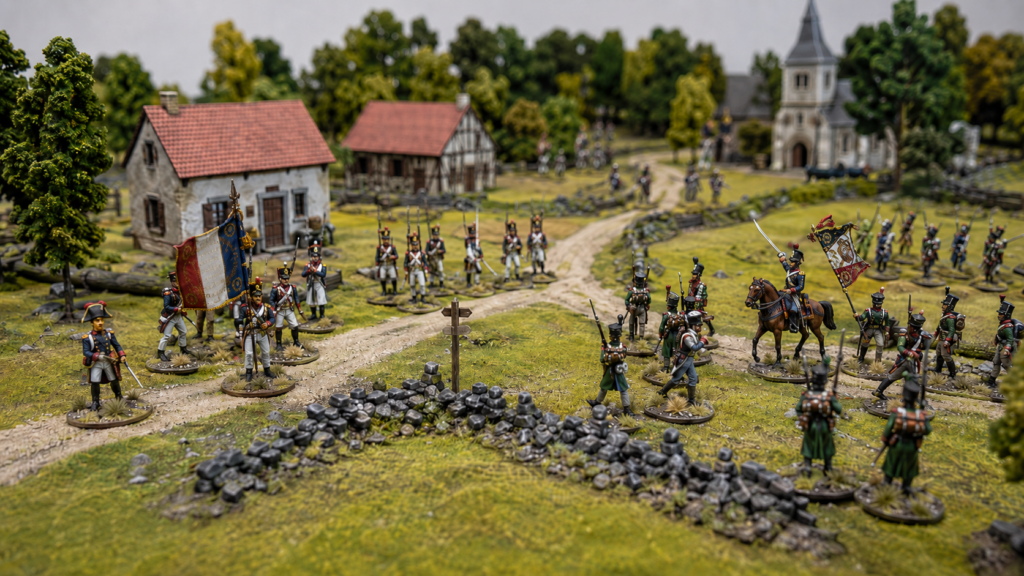
Sharp Practice by TooFatLardies is one of the strongest choices for players looking for skirmish rules for Napoleonic wargaming—provided they understand what kind of skirmish game it actually is.
This is not a one-figure-equals-one-man duel system. It is better described as a large skirmish or small-action black powder game, where leaders, small groups, deployment uncertainty, firing lines, morale pressure, and narrative battlefield moments matter more than grand tactical maneuver. TooFatLardies describes Sharp Practice as covering large skirmishes in the black powder era, commonly around 40–60 figures per side, with room to expand beyond 100 figures for larger games.
For Napoleonic players, that puts Sharp Practice in a useful middle ground: smaller and more characterful than battalion-level games like Black Powder, but more structured than a loose cinematic skirmish system.
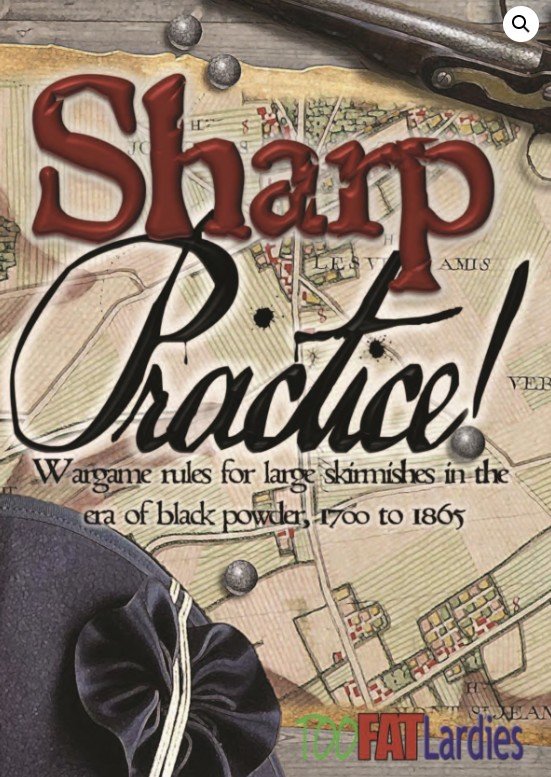
What Is Sharp Practice?
Sharp Practice is a black powder-era large skirmish rules set from TooFatLardies. The rules cover the broader period from roughly 1700 to 1865 and include army lists for several conflicts, including the Peninsular War.
For Napoleonic wargaming, its natural home is not Waterloo at corps level. It is better suited to actions such as:
- A French column probing a Spanish village
- British light infantry holding a ridge line
- Voltigeurs, riflemen, and cavalry patrols contesting a bridge
- A rearguard action during the Peninsular War
- A raid, escort mission, ambush, or outpost fight
That scenario style is where Sharp Practice earns its reputation.
Is Sharp Practice Good for Napoleonic Skirmish Games?
Yes. Sharp Practice is a very good option for Napoleonic skirmish gaming, especially if you want a game that emphasizes leaders, friction, morale, and battlefield story rather than pure unit efficiency.
The key distinction is scale. If you want a handful of named characters fencing around a farmhouse, Sharp Practice may feel too large. If you want divisions, brigades, cavalry reserves, and artillery parks, it is too small. But if you want a tabletop fight where a few groups of infantry, some skirmishers, a cavalry detachment, and memorable officers shape the action, it fits well.
How Sharp Practice Plays
Sharp Practice is built around command and control. Leaders are not decorative figures; they are the engine of the game. They activate troops, rally shock, direct movement, and create the moments that make the game feel like a period adventure rather than a spreadsheet of combat factors.
TooFatLardies describes the rules as streamlined from the first edition, with a fast-play system, command-and-control emphasis, and action that begins quickly.
That design matters for Napoleonic gaming because the period was not just about formations and firepower. It was also about hesitation, officer initiative, confusion, morale, and timing. Sharp Practice captures that at the small-action level.
Best Features of Sharp Practice for Napoleonic Wargaming
1. Leaders Matter
Many Napoleonic rules sets treat commanders as modifiers. Sharp Practice makes leaders central. A good officer can push a group forward, hold men together under pressure, or turn a small firefight into a decisive attack.
That gives the game a strong narrative structure. Players remember not just which side won, but which leader held the road, rallied the men, or led a reckless charge.
2. The Scale Is Manageable
Sharp Practice lets players build a Napoleonic force without painting an entire army. Since the game commonly uses dozens rather than hundreds of figures per side, it is a practical entry point for players who like the period but do not want to start with massive battalion collections.
This makes it especially useful for:
- New Napoleonic wargamers
- Campaign side actions
- Club nights
- Scenario-driven games
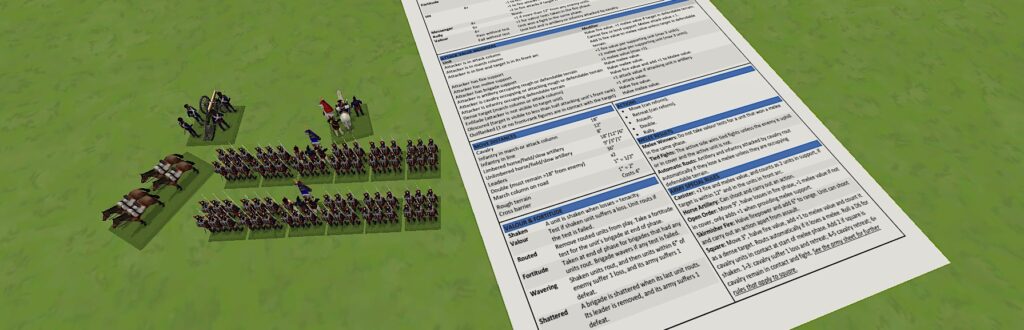
- Tabletop Simulator adaptations
- Players testing a new army before expanding into larger rules sets
3. It Rewards Scenario Design
Sharp Practice is at its best when the scenario has a purpose. A straight meeting engagement can work, but the rules shine when one side must escort a wagon, delay an enemy patrol, recover documents, capture a prisoner, or hold a village until reinforcements arrive.
That makes it ideal for Napoleonic campaigns. Instead of trying to refight Austerlitz or Salamanca, Sharp Practice lets you play the smaller incidents around the campaign: the roadblock, the farmstead, the scouting mission, the forced march, or the rearguard.
4. It Has Period Flavor Without Excessive Complexity
Sharp Practice gives players enough black powder flavor to feel grounded in the era, but it does not bury the game under formation minutiae. That is a strength for players who want Napoleonic atmosphere but not a battalion drill manual.
It is not the most granular Napoleonic simulation. That is not its purpose. Its purpose is to produce a plausible and entertaining small battle.
Where Sharp Practice Is Weaker
1. It Is Not a Grand Tactical Game
Players who want to command corps, divisions, or full brigades should look elsewhere. For that level of Napoleonic wargaming, systems such as Blücher, Eagles to Glory, or General d’Armée are more appropriate. Your existing Napoleonic rules overview can serve as an internal link here because it compares different rules sets by scale and play style.
2. It Is Not a Tiny Skirmish Game
The phrase “skirmish rules” can mislead players. Sharp Practice is skirmish-based, but it is not necessarily a five-model game. It sits above individual-duel rules and below battalion-level games.
That is why the best framing is “skirmish rules for Napoleonic wargaming“, not “man-to-man Napoleonic rules.”
3. It Requires the Right Mindset
Sharp Practice works best for players who enjoy uncertainty, narrative, and command friction. Players who want tight tournament balance or exact tactical symmetry may find it too scenario-dependent.
That is not a flaw. It is a design choice.
Sharp Practice vs. Black Powder
Sharp Practice and Black Powder rules both cover black powder-era combat, but they answer different questions.
Black Powder is better for larger tabletop spectacle: battalions, brigades, cavalry formations, artillery, and visually impressive battles. Your existing Black Powder article frames it as a good choice for club games, large-table battles, multiplayer games, and flexible horse-and-musket scenarios.
Sharp Practice is better when the question is smaller and more personal:
- Can the skirmishers hold the orchard?
- Can the officer rally his men before the French charge?
- Can the patrol escape before cavalry arrives?
- Can a village fight decide the next stage of the campaign?
The practical answer: use Black Powder for the battle; use Sharp Practice for the incident that leads to the battle.
Best Napoleonic Scenarios for Sharp Practice
Sharp Practice is especially effective for Peninsular War settings because the campaign offers ideal skirmish situations: villages, roads, hills, outposts, light troops, guerrillas, and small detachments operating away from the main army.
Strong scenario ideas include:
- British rifles and Portuguese cacadores delaying a French advance
- French voltigeurs clearing Spanish guerrillas from a village
- A cavalry patrol trying to seize a bridge before infantry arrives
- A supply convoy ambushed in broken terrain
- A rearguard action after a failed assault
- A farmhouse defense with reinforcements arriving late
This is where Sharp Practice becomes more than a rules set. It becomes a campaign engine.
Who Should Play Sharp Practice?
Choose Sharp Practice if you want:
- Skirmish-based Napoleonic games
- Lower model count than full-battle systems
- Strong leader-driven command mechanics
- Scenario play over tournament balance
- Peninsular War raids, patrols, ambushes, and village fights
- A rules set that creates memorable tabletop stories
Do not choose Sharp Practice if you mainly want:
- Full brigade or corps-level battles
- Strict historical command simulation
- Highly competitive tournament play
- A tiny character-only skirmish system
- Large Waterloo-style spectacle
Final Verdict
Sharp Practice is one of the best skirmish rules for Napoleonic wargaming if your goal is to fight small, characterful, black powder actions with leaders, friction, and narrative tension.
Its strength is not in recreating the full sweep of a Napoleonic battlefield. Its strength is in zooming in on the sharp end of the campaign: the road, the bridge, the village, the patrol, the ambush, and the officer trying to keep his men moving under fire.
For Napoleonic players who already own larger battle rules, Sharp Practice is not a replacement. It is a useful companion system. Use it to play the actions between the major battles, the episodes that a larger rules set would skip, and the small fights that give a campaign its personality.