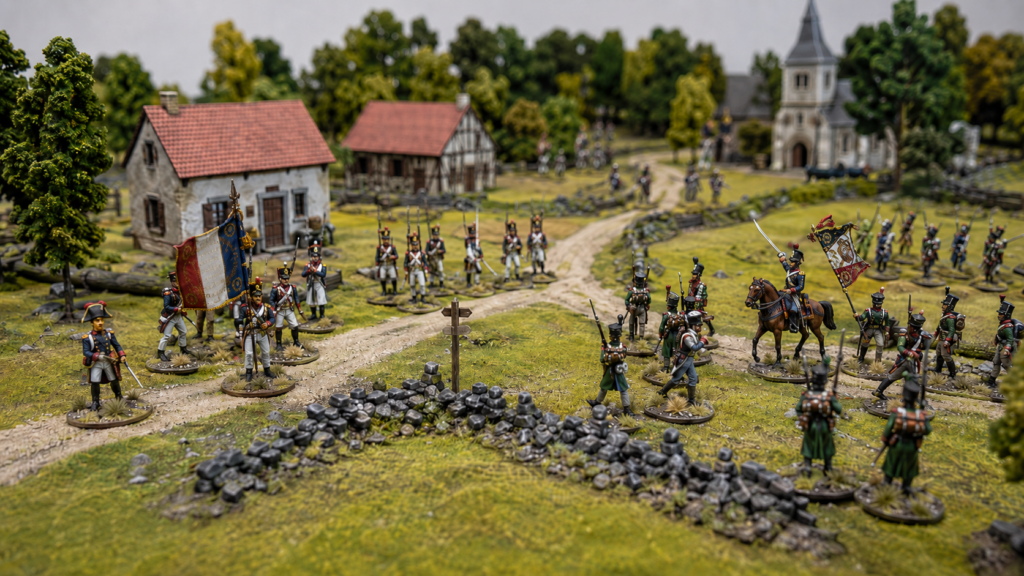
Black Powder for Napoleonic Wargaming is one of the most accessible ways to put large, colorful horse-and-musket battles on the tabletop. Published by Warlord Games, Black Powder is not limited to the Napoleonic Wars. It covers the wider 1700–1900 horse-and-musket period, including conflicts such as the American War of Independence, the American Civil War, the Anglo-Zulu War, and, of course, the Napoleonic Wars.
That broader design matters. Black Powder is not a tightly engineered Napoleonic wargames simulation in the way some period-specific rule sets try to be. It is better understood as a flexible, cinematic, club-friendly rules set that can handle Napoleonic battles very well when the players bring good scenarios, period flavor, and historically sensible army lists to the table.
For many players, that is exactly the attraction.
What Is Black Powder?
Black Powder is a tabletop miniatures wargame designed for battles from the age of linear warfare through the late 19th century. The second edition rulebook describes the game as a way to recreate the great battles of the 18th and 19th centuries with model soldiers on the tabletop.
For Napoleonic players, this means the rules can be used to fight battles involving French columns, British lines, Austrian battalions, Prussian brigades, Russian formations, Spanish armies, Portuguese troops, cavalry charges, artillery duels, and dramatic brigade-level collapses.
The game’s appeal comes from four main strengths:
- It is easy to teach.
New players can usually understand the broad turn flow after a few turns. - It handles large tables well.
The system is built for spectacle: ranks of infantry, cavalry on the flanks, artillery batteries, and sweeping movement. - It is scenario-friendly.
Players can create historical, semi-historical, fictional, and campaign-linked battles without needing a rigid points structure. - It is flexible about scale and basing.
Although strongly associated with 28mm miniatures, many groups adapt it for other figure scales.
That flexibility is both a strength and a weakness. Players who want a tightly balanced tournament system or a deeply granular model of Napoleonic command may find Black Powder too loose. Players who want a fast, attractive, narrative battle will likely find it more rewarding.
Is Black Powder Good for Napoleonic Wargaming?
Yes, Black Powder for Napoleonic wargaming is a good choice, especially if the goal is to play visually impressive battles with straightforward mechanics and room for scenario design.
It is strongest when used for:
- Club games
- Large-table battles
- Multiplayer games
- Convention games
- Casual campaigns
- Scenario-driven Napoleonic actions
- Players who value speed over fine-grained simulation
It is weaker if the goal is:
- Strict battalion-by-battalion historical modeling
- Deep army-level command friction
- Highly detailed national doctrine
- Competitive tournament precision
- Exact simulation of corps-level Napoleonic operations
This is where expectations matter. If you want the grand tactical sweep of corps and army-level maneuver, a system like Blücher may be a better fit. If you want streamlined division and corps command with minimal bookkeeping, Eagles to Glory may be a stronger alternative.
But if you want a big table, attractive troops, flexible scenarios, and enough friction to produce a lively battle, Black Powder for Napoleonic wargaming remains one of the most approachable options.
How Black Powder Plays on the Table
A typical game of Black Powder moves through command, movement, shooting, hand-to-hand combat, morale effects, and break tests. The rules are not built around micromanaging every formation change or every tactical detail. Instead, the player is usually thinking in terms of brigades, broad positioning, timing, and battlefield momentum.
The system rewards players who understand basic Napoleonic principles:
- Keep reserves available.
- Use artillery to soften targets.
- Avoid unsupported cavalry charges.
- Coordinate infantry attacks.
- Protect flanks.
- Do not allow brigades to become isolated.
- Use terrain to anchor a defensive line.
The game does not force perfect historical behavior by itself. That is important. Black Powder works best when players build scenarios that reward period-appropriate decisions. Without that, the game can become too loose.
That is not a flaw so much as a design assumption: Black Powder expects players to care about the period.
Command and Control in Black Powder
Command is one of the defining features of Black Powder. Rather than allowing every unit to move exactly as planned, commanders issue orders, and dice determine how effectively those orders are carried out.
This creates a practical form of command friction. A brigade may surge forward faster than expected. Another may refuse to move. A critical attack may develop too slowly. A reserve may fail to arrive when needed.
For Napoleonic games, this is valuable because the period was rarely about perfect mechanical control. Corps, divisions, brigades, and battalions operated through orders, interpretation, personality, distance, smoke, confusion, and imperfect timing.
That said, Black Powder command friction is broad rather than deeply Napoleonic. It gives uncertainty, but it does not model staff systems, corps doctrine, or national command structures in the same detail as some more specialized Napoleonic rule sets.
For many groups, that trade-off is acceptable because it keeps the game moving.
Shooting, Artillery, and Melee
In Black Powder, combat is intended to resolve quickly enough to keep the battle flowing. Shooting matters, especially when units are already under pressure, but the game does not usually turn into a slow exchange of musketry unless the scenario or terrain creates that situation.
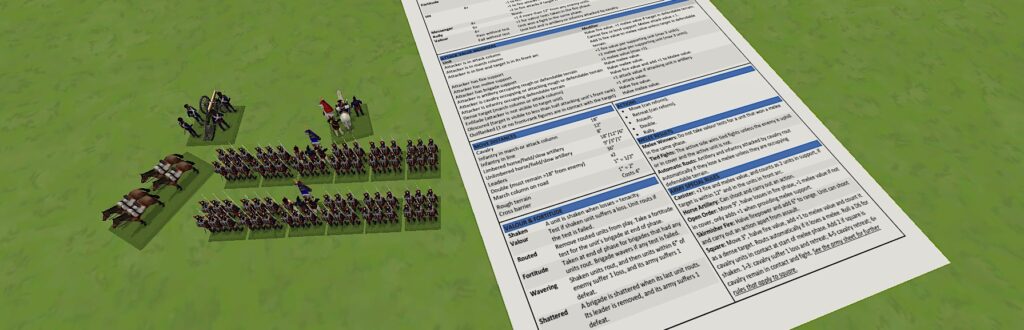
Artillery can be especially important because it shapes movement and morale. In the quick reference material, artillery casualties can affect break tests, making artillery fire more than just a way to remove figures. It contributes to the pressure that can cause units to falter or collapse.
Hand-to-hand combat tends to be decisive. When formations close, the result can quickly create retreats, disorder, or broken units. This gives the game a dramatic rhythm: maneuver, fire, pressure, charge, collapse, exploit.
That rhythm suits Napoleonic games well, provided players do not treat every unit as if it should fight independently. Napoleonic battles work best when brigades and divisions are used in coordinated fashion.
Morale, Disorder, and Break Tests
The morale system is one of the areas where Black Powder creates battlefield drama without excessive bookkeeping.
Units can become disordered. They can suffer casualties. They can be forced to test after shooting or hand-to-hand combat. In the uploaded quick reference sheet, break test modifiers include penalties for excess casualties, being disordered, and suffering artillery casualties in certain tests. Break tests can be triggered by shooting, hand-to-hand defeat, drawn combat when shaken, and nearby supporting units breaking.
This matters because units do not simply fight until every figure is gone. A unit may retire, hold, or break depending on circumstances and die results. That gives Black Powder a useful morale-based feel. Battles are often decided by cohesion and timing, not just attrition.
For Napoleonic wargaming, that is a good design choice. Real formations often failed because they lost cohesion, confidence, or support—not because every soldier became a casualty.
What Scale Does Black Powder Use?
Black Powder for Napoleonic wargaming is commonly associated with 28mm miniatures, and Warlord’s own Waterloo starter set is built around that scale.
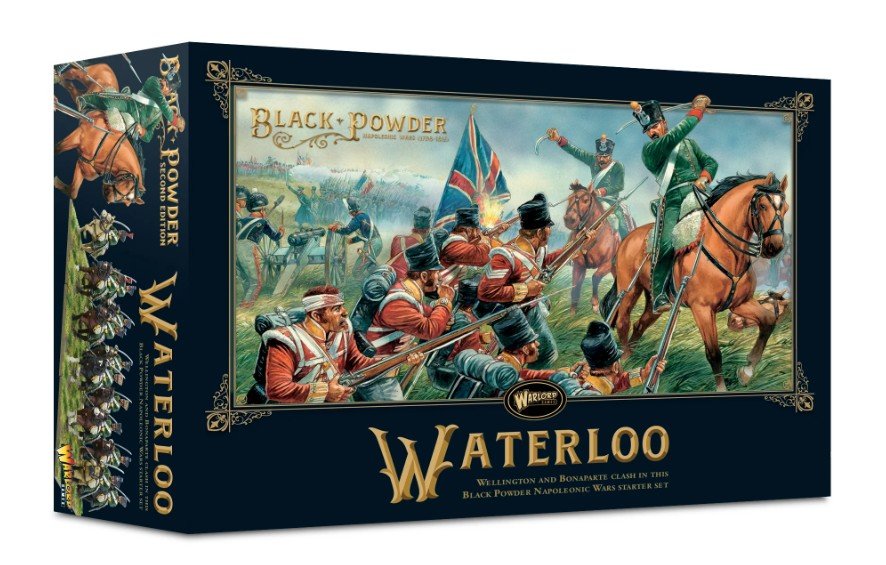
However, many players adapt the rules to other figure scales. The key is consistency. Players should agree on:
- Unit frontage
- Movement distances
- Firing ranges
- Table size
- Basing conventions
- Scenario scale
- What a unit represents
For 28mm Napoleonic games, Black Powder looks impressive but requires more table space and more miniatures. For smaller scales, such as 15mm, 10mm, 6mm, or Warlord’s Epic-scale ranges, the game can cover larger battles in less space, but some measurement adjustments may be needed. Warlord community discussion has noted that while Black Powder was designed around 28mm, players do adapt it for Epic-scale games using changes such as centimeters instead of inches or reduced ranges.
The practical advice: choose the visual scale you enjoy, then standardize the table conventions before the first game.
What Do You Need to Start Playing Black Powder for Napoleonic Wargaming?
To start playing Black Powder for Napoleonic Wargaming, you need:
- The Black Powder II rulebook
- Napoleonic miniatures or suitable proxies
- A table with terrain
- Six-sided dice
- Measuring tools
- Unit labels or roster sheets
- A basic scenario
- Two balanced forces
For a first game, do not start with Waterloo. That is the wrong instinct. A massive battle may be inspiring, but it is a poor teaching tool.
A better first scenario would include:
- 2–3 infantry brigades per side
- 1 cavalry brigade per side
- 1–2 artillery batteries per side
- A simple objective
- Limited terrain
- A clear turn limit
The best first game is not the biggest game. It is the game that teaches movement, command, firing, melee, disorder, and break tests without burying the players.
Recommended First Napoleonic Scenario Structure
A good beginner scenario could be built around a fictional French attack on an Allied-held ridge or village.
| Element | Recommendation |
|---|---|
| Table Size | 6′ x 4′ if using 28mm; smaller scales can adjust |
| Forces | French attack vs. British/Portuguese, Austrian, Prussian, Russian, or Spanish defense |
| French Army | 2 infantry brigades, 1 cavalry brigade, 1 artillery battery |
| Allied Army | 2 infantry brigades, 1 light cavalry brigade, 1 artillery battery |
| Objective | Take and hold a village, ridge, bridge, or crossroads |
| Turn Limit | 6–8 turns |
| Victory Condition | Control the objective and avoid brigade collapse |
This format teaches the rules without turning the first session into a rules search exercise.
Black Powder Compared to Other Napoleonic Rule Sets
Black Powder occupies a specific place in the Napoleonic rules landscape.
| Rules Set | Best For | Compared to Black Powder |
|---|---|---|
| Blücher | Grand tactical corps and army maneuver | More operational; less focused on tabletop spectacle |
| Eagles to Glory | Division and corps command with streamlined mechanics | More Napoleonic-command focused |
| Valour & Fortitude | Fast-play accessible battles | Even lighter and faster; good for quick games |
| General d’Armée 2 | Detailed tactical/divisional command | More friction and period detail |
| Lasalle 2 | Smaller tactical Napoleonic games | More focused and compact |
This comparison should not be framed as “which rules are best?” A better question is: what kind of Napoleonic battle do you want to play?
Choose Black Powder for Napoleonic wargaming if you want the game to feel like a large, dramatic tabletop battle. Choose another system if you want more exact modeling of Napoleonic command, formation doctrine, or operational maneuver.
Useful Black Powder Napoleonic Supplements
For Napoleonic players, the Albion Triumphant supplements are especially relevant. Albion Triumphant Volume 1 focuses on the Flanders and Peninsular campaigns and includes Napoleonic army lists, background, troop stats, and scenarios.
Albion Triumphant Volume 2 covers the Hundred Days campaign and includes army lists, background, troop stats, and scenarios for Waterloo-era gaming. Warlord notes that the Black Powder rulebook is required to use the supplement.
For players specifically interested in British, French, Portuguese, Spanish, Prussian, Dutch-Belgian, or Waterloo campaign forces, these supplements are useful because they add period flavor that the core rules alone cannot fully provide.
Strengths of Black Powder for Napoleonic Wargaming
1. It Is Approachable
The basic structure is easy to teach compared to many historical miniatures systems. That makes it a practical choice for clubs and mixed-experience groups.
2. It Looks Good on the Table
Some rule sets are elegant but visually modest. Black Powder is built for the spectacle of massed miniatures.
3. It Handles Multiplayer Games Well
Because the system is relatively easy to understand, multiple players can each command brigades without needing to master every rule before the first turn.
4. It Encourages Scenario Play
The rules are flexible enough to support historical refights, fictional campaigns, and what-if battles.
5. It Does Not Require Excessive Bookkeeping
Players track key battlefield conditions without needing to maintain heavy rosters for every unit.
Limits of Black Powder for Napoleonic Wargaming
The main weakness of Black Powder is also part of its charm: it is broad.
Because the rules cover more than just the Napoleonic Wars, they do not always provide the depth that some Napoleonic specialists want. Players may need supplements, house rules, or careful scenario design to bring out stronger national differences and period-specific doctrine.
Potential limitations include:
- Command is abstract rather than deeply historical.
- National characteristics may need scenario support.
- Competitive balance depends heavily on player agreement.
- Large 28mm games require considerable space.
- Some outcomes can feel swingy if players expect tight simulation.
- Loose play can reward ahistorical tactics unless scenarios discourage them.
This is why Black Powder is best treated as a flexible framework, not a complete Napoleonic simulation engine.
Best Practices for a Better Black Powder Napoleonic Game
To get the best results, do not simply place two equal armies on opposite sides of the table and charge forward.
Use these practices instead:
Build Around a Scenario
Napoleonic battles need context. Give each side a mission, timetable, deployment condition, or reinforcement schedule.
Limit the First Game
Keep the first battle small. Learn the rules before scaling up.
Use Terrain With Purpose
Villages, ridges, roads, streams, bridges, woods, and walls should shape tactical choices.
Give Brigades Clear Roles
Avoid building armies as random collections of units. Think in terms of advance guards, main lines, reserves, cavalry wings, and artillery support.
Add Period Flavor Carefully
Use supplements or light house rules to represent national differences, but do not overload the system.
Debrief After the Game
Because Black Powder is flexible, each group should review what worked, what felt wrong, and what should be adjusted next time.
Frequently Asked Questions About Black Powder for Napoleonic Wargaming
Is Black Powder a Napoleonic-only rules set?
No. Black Powder covers the broader horse-and-musket period from 1700–1900, including but not limited to the Napoleonic Wars.
Is Black Powder good for beginners?
Yes. It is one of the more approachable historical miniatures systems for players who want large battles without excessive rules overhead.
What miniatures scale is best for Black Powder?
28mm is the most common presentation, especially through Warlord Games products, but smaller scales can work well if the players adjust basing and distances consistently.
Can Black Powder be used for Waterloo?
Yes. Warlord Games offers Waterloo-focused products and the Albion Triumphant Volume 2 supplement supports the Hundred Days campaign.
Is Black Powder historically accurate?
It can produce historically plausible games, but it is not a strict simulation. Historical accuracy depends heavily on scenario design, army lists, terrain, objectives, and player behavior.
What is the biggest reason to play Black Powder?
Play Black Powder for Napoleonic wargaming if you want a flexible, attractive, fast-moving Napoleonic battle that works well for club gaming and scenario play.
Final Verdict: Who Should Play Black Powder?
Black Powder for Napoleonic Wargaming is best for players who want the look and drama of Napoleonic battles without turning every turn into a rules consultation.
It is not the most detailed Napoleonic rules set. It is not the strongest grand tactical command system. It is not the best choice for players who want every national doctrine modeled with precision.
But it is one of the best choices for getting impressive Napoleonic armies onto the table and playing a lively, understandable, dramatic game.
For many wargamers, especially clubs and visually oriented players, that is enough reason to keep Black Powder for Napoleonic wargaming in regular rotation.